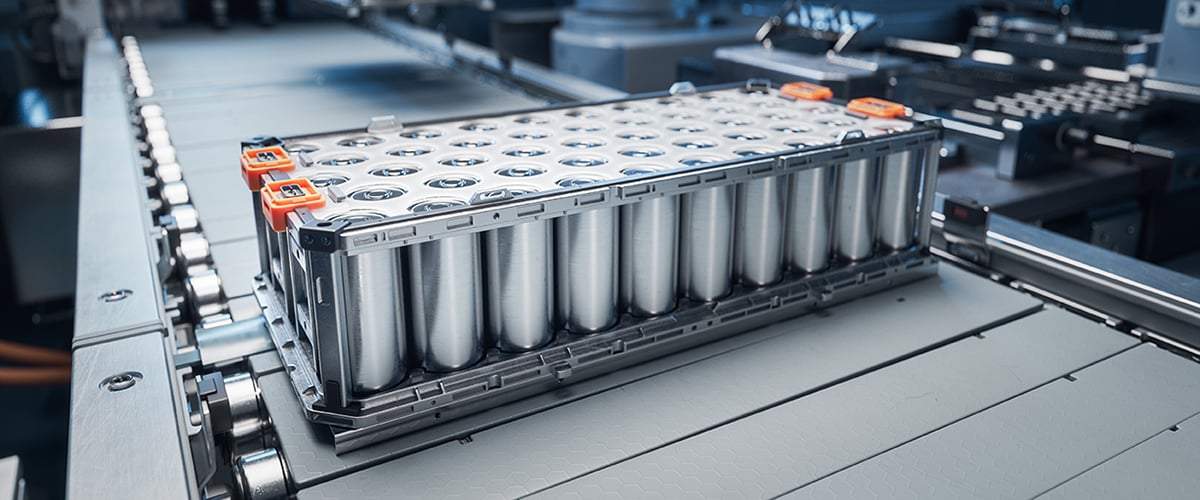
The lithium battery industry is expanding rapidly worldwide, with equipment manufacturers scaling global supply chains to meet rising demand. Overseas orders continue to grow, accelerating international deployment. Welding equipment, a core component of lithium battery production, reflects this trend. However, exporting equipment introduces complex challenges, including varying regional regulations, stringent certification requirements and the need to align safety functions with local standards. As a result, functional safety has become a critical barrier to global deployment—and a key enabler of global market access and competitiveness.
Challenge
High-speed lithium battery welding equipment must deliver extreme precision while ensuring operator safety around large-format machines. As battery production globalizes, OEMs face several technical challenges.
First, functional safety requirements vary by region. Equipment must comply with international standards such as ISO and EU CE to enable market access.
At the same time, systems must balance safety and productivity. Large-format machines are significantly larger than standard welders, and operators often enter the work area for maintenance. Traditional approaches, such as Safe Torque Off (STO), protect personnel but can cause full shutdowns, which reduce productivity.
Finally, expanding demand in Europe and other highly regulated markets requires advanced capabilities, including speed monitoring and reliable fault response to compete globally. These functions extend beyond basic stop-based safety and often aren’t supported by conventional systems.
Solution
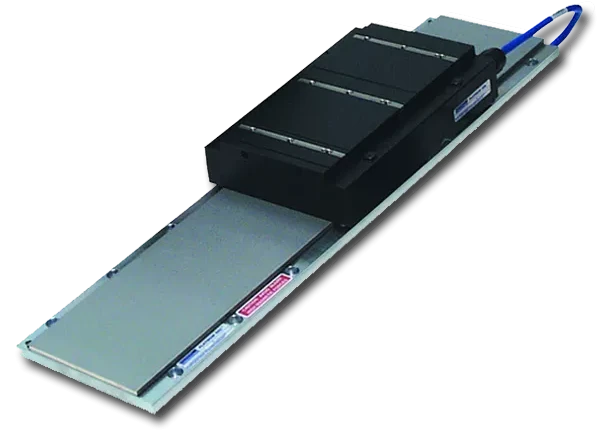
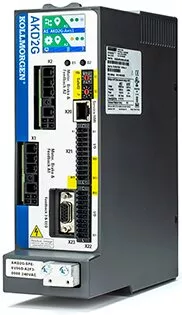
Kollmorgen delivered an integrated solution that combines the AKD2G servo drive with SafeMotion™ Monitor (SMM 3.0) functionality and IC linear motors, to address global compliance, safety and productivity requirements.
SMM 3.0 fully integrates 16 certified safety functions directly into the drive, eliminating complex external integrations while supporting global safety standards. Paired with IC linear motors, the system provides the dynamic performance and responsiveness required for high-speed welding. When combined with third-party safety-rated encoders and grating systems, the solution provides precise position feedback and real-time safety monitoring to achieve micrometer-level positioning accuracy and stable weld quality.
During maintenance, the system automatically activates a safe limited-speed mode. This allows operators to maintain core machine functionality while limiting axis motion to predefined safe thresholds, reducing the risk of accidental contact. Additionally, clear visual indication of low-speed operating status improves visibility and operator confidence during service.
Results
With SMM 3.0 integrated into the motion architecture, the welding equipment delivers both high performance and safety compliance.
Welding speeds reach 300 mm/s while maintaining consistent weld quality. For 360 mm × 40 mm battery dimensions, efficiency reaches 34 ppm, with peak speed fluctuation capped at 5.6‰ and reduced to 2.8‰ during steady-state operation. The result is stable, high-efficiency production with improved weld consistency.
The integrated Safe Limited Speed (SLS) function supports EU-compliant speed control and simplifies validation for deployment in Europe and North America, strengthening competitiveness in regulated global markets. By delivering both safety and productivity, this solution sets a new benchmark for prismatic battery top cover sealing welding.
Safety is not only a robust safeguard for personnel and equipment but also an enhancement of the equipment’s intrinsic value. It delivers competitive advantages to enterprises, representing a significant opportunity for equipment manufacturers to stand out in the marketplace.