blog | The Big Debate – Stepper vs Servo |
|
2 minute read

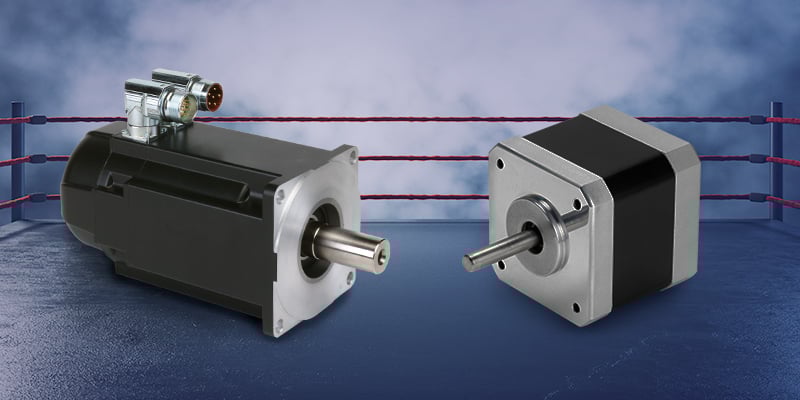
What is the best motor technology to use in a motion control application? There are numerous technologies to create motion, from hydraulic to pneumatic or electromechanical. In the world of precision motion control, many machine designers face a choice between step motor or servo motor technologies to solve their performance requirements. Both stepper motors and servo motors have a place in the motion control world but understanding when to use each has created a big debate.

Let’s check in on the ongoing debate of stepper vs servo…
Engineer A: “I like using stepper motors. They are simple to use, easy to set up and are reliable. I don’t need a lot of fancy control schemes to get my system from point A to point B.”

Engineer B: “I prefer a servo motor. The ability to cover a wide speed and torque range suits my multi-axis machine design perfectly.”

The engineers in this debate come from two different industries and have vastly different mechanical systems. Engineer A likes the simplicity of the stepper motor – from its set up and operation to how easy it is to get up and running. Based on the comment about point-to-point positioning, Engineer A has likely chosen the best solution for their particular machine. Stepper motors are a solid choice for simple point to point applications where load disturbances are minimal. Engineer B prefers the broad capabilities of servo motors, which makes sense in applications that require precise control and have multiple axes of coordinated motion. The high bandwidth and precision control of closed loop servo motors makes tight coordinated motion possible for multi-axis machinery.

Engineer B: “I had a bad experience with stepper motors when we attempted to use them on an axis with varying load disturbances.”

Engineer A: “I tried using a servo, but when it reached position it moved back and forth slightly as it came to a stop, which caused issues in the product finish.”

When Engineer B used a stepper motor on an axis that had some unpredictable load disturbances, some of these variations caused the motor to lose count, which eventually caused position errors. While this issue can be corrected by adding feedback to the stepper motor, it highlights one application where the open loop stepper may not be the best choice. In Engineer A’s case, an improperly tuned servo motor may “hunt” for position. Move and settle times can vary from application to application depending on motor sizing, inertia mismatch, and servo loop tuning. In the case of a simple point to point move with minimal load disturbances, a stepper motor is likely a better choice to stop at the designated point and hold position without hunting.

For Engineer A, the simple point to point positioning was best served using a stepper motor, while for Engineer B, the multi-axis coordination was better accommodated with servo motors. This “debate” explores only a few attributes that can influence the choice of servo vs stepper. To help determine which motor technology best fits each situation, Kollmorgen reviews numerous application attributes in the white paper “Stepper Motor vs Servo Motor – Which Should it Be?”

Consult an Expert

AKME Series Servo Motors

AKME Series is built on the AKM platform and designed for use in Zone 2 and Zone 22 environments with ATEX and IECEx global certification.
Learn More

AKMA Servo Motors

The lightweight AKMA servo motor is designed for harsh environments like food and beverage processing, and delivers performance and reliability.
Learn More

Engineer the Exceptional

Learn how to engineer exceptional machines, robots and vehicles with the highest-performing, most reliable motors, drives, automation solutions and more.

Learn More

Related Resources

Kollmorgen HV Essentials

Kollmorgen Introduces New Controller and High-Voltage Capability in its Essentials Portfolio >

Kollmorgen Essentials adds a new eight-axis controller and high-voltage drive capability to right-size motion system builds for industrial applications.
Choosing the Right Motor for HazLoc Machine Needs: Zone 2 and Zone 22 Made Simple

Choosing the Right Motor for HazLoc Machine Needs: Zone 2 and Zone 22 Made Simple >

Introducing Kollmorgen’s AKME servo motors—ATEX/IECEx certified and engineered for compact, versatile performance in hazardous environments where choices have been limited—until now.
Kollmorgen Essentials™: Complete Motion Systems for Every Axis, Every Budget

Kollmorgen Essentials™: Complete Motion Systems for Every Axis, Every Budget >

Discover how Kollmorgen Essentials delivers high‑precision motion and proven reliability—now faster to specify, simpler to integrate, and more affordable to scale. The new Kollmorgen Essentials line introduces complete, pre-engineered motion control…
English, UK
Kollmorgen Essentials™: Sistemas de movimiento completos para cada eje y cada presupuesto (Español)

Kollmorgen Essentials™: Sistemas de movimiento completos para cada eje y cada presupuesto (Español) >

Descubre cómo Kollmorgen Essentials ofrece control de movimiento de alta precisión y fiabilidad comprobada, ahora más rápido de configurar, más fácil de integrar y más rentable de escalar.
Español
Kollmorgen Essentials™: Complete Motion Systems for Every Axis, Every Budget

Kollmorgen Essentials: Complete Motion Systems for Every Axis, Every Budget >

Discover how Kollmorgen Essentials delivers high‑precision motion and proven reliability—now faster to specify, simpler to integrate, and more affordable to scale. The new Kollmorgen Essentials line introduces complete, pre-engineered motion control…
How Kollmorgen Motion System Powers a Cable Robot to Triple Throughput

How Kollmorgen Motion System Powers a Cable Robot to Triple Throughput >

Learn why Rbot9 specified AKM2G servo motors and AKD servo drives to maximize the payload capacity, speed and vertical-load safety of its massive, suspended-cable robot.
Which Servo Position Feedback Device Is Right for Your Application?

Which Servo Position Feedback Device Is Right for Your Application?  >

Choose the right feedback device for your application. Learn how to achieve maximum performance, efficiency and value with a multi-turn absolute rotary encoder.
Kollmorgen’s new SFD-M high-resolution encoder offers multi-turn absolute feedback at zero incremental cost

Kollmorgen’s new SFD-M high-resolution encoder offers multi-turn absolute feedback at zero incremental cost >

Kollmorgen’s battery-free SFD-M encoder provides absolute 16-bit multi-turn positioning data at system power up with zero incremental cost. Eliminate homing sequences and maintain positioning accuracy through 65,536 complete motor revolutions for a…
What are the differences between DC, BLDC and AC servo motors?

What are the differences between DC, BLDC and AC servo motors? >

Understand the differences between DC servo motors, BLDC servo motors and AC servo motors. Selecting the right type for your application is critical for optimal performance, efficiency and longevity.