blog | Applications Sizing - Part 1: Getting Started Sizing Servos |
|
2 minute read

Never sized a servo before? Well, we want to share with you some of the best practices we have found over the years. Over the next few months, we will continue this series with a variety of tidbits that will help you become more comfortable with the job of sizing a servo. In this post, we’ll start with the basics of good preparation.

It begins by understanding the different components that make up a servo motor and drive system. Servos are closed loop systems because they regulate some desired function by incorporating feedback – much like the cruise control in your car. You set the desired speed and the cruise control determines how much throttle is required to keep the car moving at the desired speed. In the servo systems we deal with, a feedback device provides constant feedback between motor and drive in order to precisely regulate the speed and/or torque of the motor being driven. Most often these are highly dynamic systems involving rapid load accelerations and decelerations. They operate in all 4 quadrants, meaning they control torque and speed whether positive or negative.
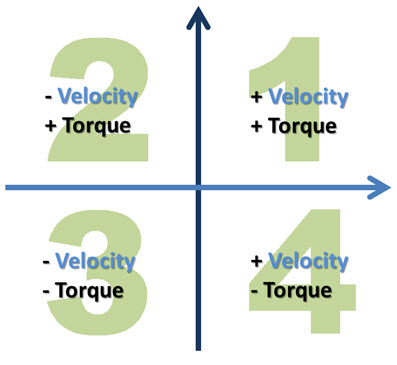
Four Quadrant Operation

Sizing a servo requires a system solution. The system includes a definition of the mechanical load, motion profile including positioning requirements, the servo motor characteristics, and the environment in which the motor and other components are placed. 

Let’s begin with an understanding of the implications of the mechanical load and motion requirements. Basic Newtonian physics teaches us that force (or torque in rotary terms) is proportional to the mass (rotary inertia) times the acceleration rate, whether positive or negative. Therefore, it’s important to accurately define the mechanics, specifically the masses in motion, and the required motion profile. Along with the motion profile it’s important to understand the actual positioning requirements of the load in terms of resolution, accuracy and repeatability (something we’ll touch on in a future blog post). This will be directly affected by the feedback device selection, but also any lost motion such as backlash or compliance in the mechanical system.

Unless a direct drive motor system is being considered, the mechanism will include one or more mechanical transmissions. A linear to rotary transmission might be accomplished by a pulley driven belt or screw based mechanism like a ballscrew - just as a couple of examples.
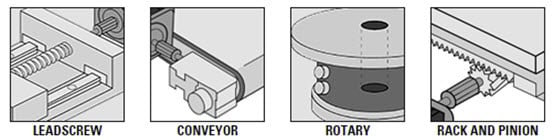
Servo Mechanisms

Rotary transmissions include gearboxes or belt driven reducers providing speed reduction by means of different size pulleys. In some applications the part being moved makes a significant contribution to the total moving mass. A changing mass as in the case of robotic systems, must also be understood since the amount of total load change can be a factor in the tuning of the servo drive.

The components in motion need to have their inertias summed and reflected back to the motor shaft. In addition to the inertia, external forces, friction and inefficiencies need to be taken into consideration.  All of this will determine the speed/torque characteristics required to meet the performance criteria of your application.

So that's quite a bit to take in for our first venture into sizing, but hang in there, it will all make sense as we tie this together.  Before we close this post, let's quickly review some of the key elements to consider:

  1. Understand your mechanical load and how it will connect to the servo motor
  2. Motion profile and positioning requirements
  3. The characteristics of the servo motor technology being considered
  4. The environment all this will operate in
 
Try out Kollmorgen’s MOTIONEERING Online Sizing tool and learn about what parameters you need to run through a sizing exercise.

Consult an Expert

AKME Series Servo Motors

AKME Series is built on the AKM platform and designed for use in Zone 2 and Zone 22 environments with ATEX and IECEx global certification.
Learn More

AKMA Servo Motors

The lightweight AKMA servo motor is designed for harsh environments like food and beverage processing, and delivers performance and reliability.
Learn More

Engineer the Exceptional

Learn how to engineer exceptional machines, robots and vehicles with the highest-performing, most reliable motors, drives, automation solutions and more.

Learn More

Related Resources

Kollmorgen HV Essentials

Kollmorgen Introduces New Controller and High-Voltage Capability in its Essentials Portfolio >

Kollmorgen Essentials adds a new eight-axis controller and high-voltage drive capability to right-size motion system builds for industrial applications.
Choosing the Right Motor for HazLoc Machine Needs: Zone 2 and Zone 22 Made Simple

Choosing the Right Motor for HazLoc Machine Needs: Zone 2 and Zone 22 Made Simple >

Introducing Kollmorgen’s AKME servo motors—ATEX/IECEx certified and engineered for compact, versatile performance in hazardous environments where choices have been limited—until now.
Kollmorgen Essentials™: Complete Motion Systems for Every Axis, Every Budget

Kollmorgen Essentials™: Complete Motion Systems for Every Axis, Every Budget >

Discover how Kollmorgen Essentials delivers high‑precision motion and proven reliability—now faster to specify, simpler to integrate, and more affordable to scale. The new Kollmorgen Essentials line introduces complete, pre-engineered motion control…
English, UK
Kollmorgen Essentials™: Sistemas de movimiento completos para cada eje y cada presupuesto (Español)

Kollmorgen Essentials™: Sistemas de movimiento completos para cada eje y cada presupuesto (Español) >

Descubre cómo Kollmorgen Essentials ofrece control de movimiento de alta precisión y fiabilidad comprobada, ahora más rápido de configurar, más fácil de integrar y más rentable de escalar.
Español
Kollmorgen Essentials™: Complete Motion Systems for Every Axis, Every Budget

Kollmorgen Essentials: Complete Motion Systems for Every Axis, Every Budget >

Discover how Kollmorgen Essentials delivers high‑precision motion and proven reliability—now faster to specify, simpler to integrate, and more affordable to scale. The new Kollmorgen Essentials line introduces complete, pre-engineered motion control…
How Kollmorgen Motion System Powers a Cable Robot to Triple Throughput

How Kollmorgen Motion System Powers a Cable Robot to Triple Throughput >

Learn why Rbot9 specified AKM2G servo motors and AKD servo drives to maximize the payload capacity, speed and vertical-load safety of its massive, suspended-cable robot.
Which Servo Position Feedback Device Is Right for Your Application?

Which Servo Position Feedback Device Is Right for Your Application?  >

Choose the right feedback device for your application. Learn how to achieve maximum performance, efficiency and value with a multi-turn absolute rotary encoder.
Kollmorgen’s new SFD-M high-resolution encoder offers multi-turn absolute feedback at zero incremental cost

Kollmorgen’s new SFD-M high-resolution encoder offers multi-turn absolute feedback at zero incremental cost >

Kollmorgen’s battery-free SFD-M encoder provides absolute 16-bit multi-turn positioning data at system power up with zero incremental cost. Eliminate homing sequences and maintain positioning accuracy through 65,536 complete motor revolutions for a…
What are the differences between DC, BLDC and AC servo motors?

What are the differences between DC, BLDC and AC servo motors? >

Understand the differences between DC servo motors, BLDC servo motors and AC servo motors. Selecting the right type for your application is critical for optimal performance, efficiency and longevity.