 Home >
 Knowledge Base >
 FAQs >
 Downloads >
AKD Single Phase Supply Operation
Over the years, Kollmorgen has offered 120V/230V drives that can operate on a single phase AC supply. Most of these are for laboratory or college applications. In some cases, these applications experience under voltage faults or bus capacitor over load faults when the motor is operated aggressively. I wanted to take some time to explain the related parameters and issues.
Table of Contents
Single Phase Current:
It takes 1.73 times single phase current to produce three phase current. If I were to command 1 amp to the motor, the single phase AC input will be 1.73A
Frequency:
For the AC supply to charge the DC bus, the phase voltage must be higher than the existing bus voltage so the diode will commutate. When using 3 phase AC supply, each phase peak is 60 deg apart from each other. The bus is replenished every 2.8mS (60Hz) as the AC line voltage exceeds the bus voltage six times in a 16.6mS period.
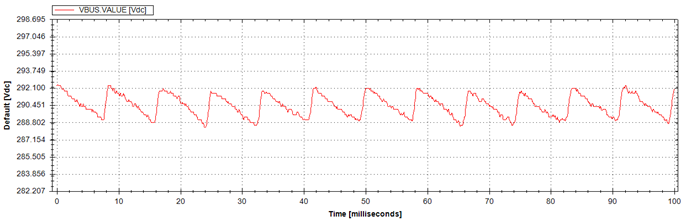
Using single phase, the bus is refreshed every 8.3mS (60Hz), two times in a 16.6mS period. This can be an issue because it’s possible to dissipate the energy in the DC Bus in less than 5mS. Here is a plot of the bus voltage with single phase 230V applied (same load as above):
Power factor:
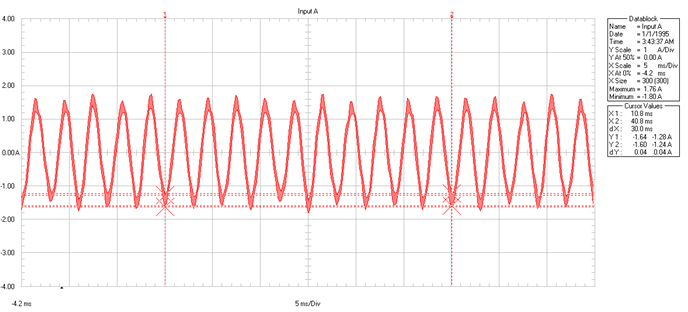
The drive supplies current to the motor with very good efficiency. About 95~98% efficient. Here is a plot of U phase current with a 1A command to a motor turning 5000 RPM
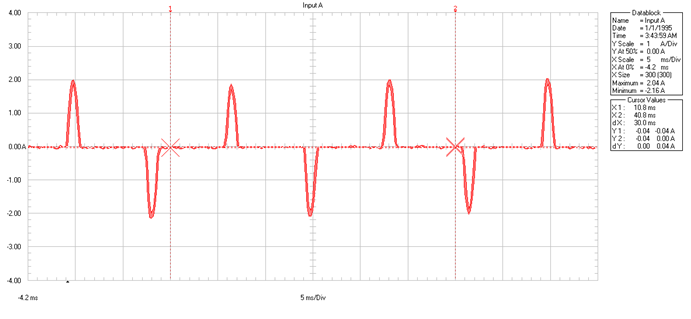
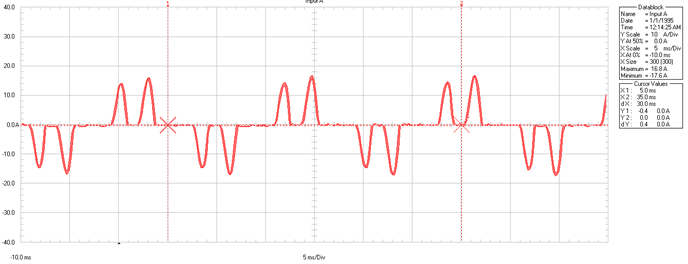
The drive doesn’t pull current, from the AC supply, very efficiently. approximately 65~70% efficiency. This means the input AC RMS current is the same but the peak current is higher. This is also why non-true RMS amp clamps will not measure correctly. Here is the same 1A command, but measuring the AC input current:
Watts:
The work done by the motor is measured in power. Power is “velocity x torque”. So, even if the torque is the same…a motor working at a higher speed will have more watts. The laws of conservation of energy say the power in must equal the power out. On the other hand, the AC input is a fixed voltage. The only variable is the input current. So, as the motor increases in speed, even with constant torque, the input current will increase.
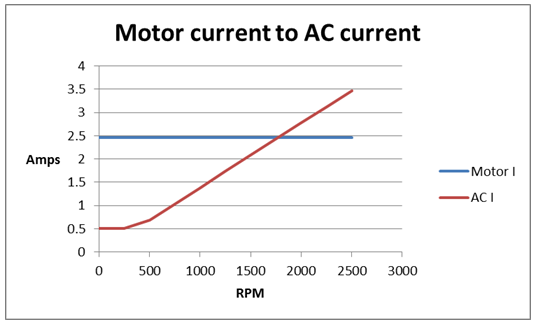
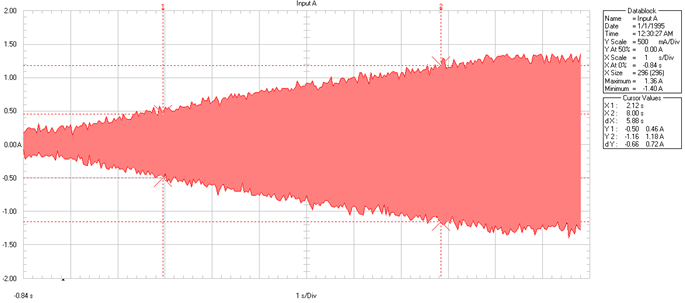
This is an interesting plot. The motor is unloaded. The plot is AC input current as the motor accelerates, from 0 to 3000 RPM, at a rate of 300 RPM/s. The motor phase current remains constant around 0.2A. (This plot is the same measurement as the AC input current above, I just increased the time/division so the pulses would run together)
AC supply limit:
I don’t know about other parts of the World but in the USA, we have limits to our 120V supply. 15A is standard but 20A is available with a special receptacle. So, depending on your application, you could exceed the current limits of the supply. The result is the AC line voltage will dip. Also, keep in mind the power factor will make 15A seem like 20A to a circuit breaker.
Putting it all together:
First, a step response with 3 phase AC input. Here is a 12A step response in torque mode.
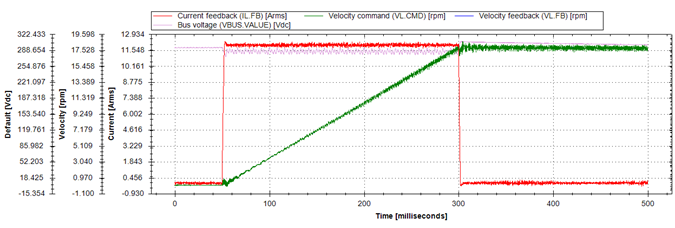
Here is one of the three phase input current during the above move. Notice the peak is below 18A.
Second, here is the exact same step response with only one phase AC input. Notice the bus voltage ripple.
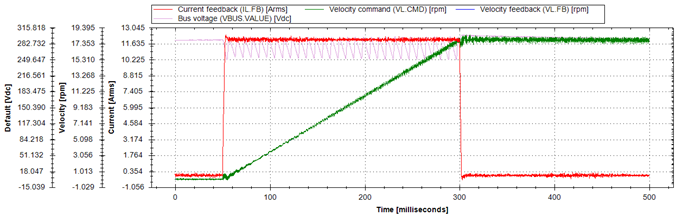
Here is the AC input current for the above step response. Notice the peak is close to 40A.
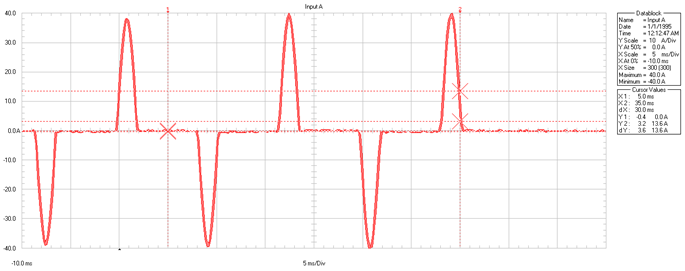
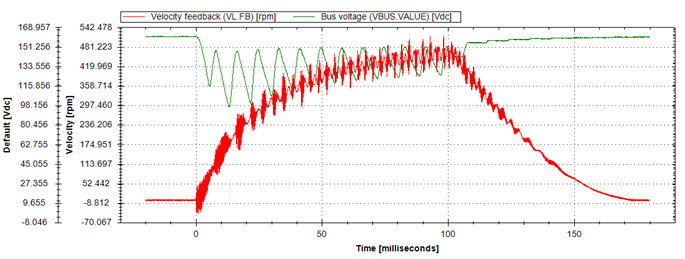
OK, back to the faults: If you were to plot the velocity and bus voltage during a high velocity mode acceleration, it would look like this:
Here is an under voltage fault:
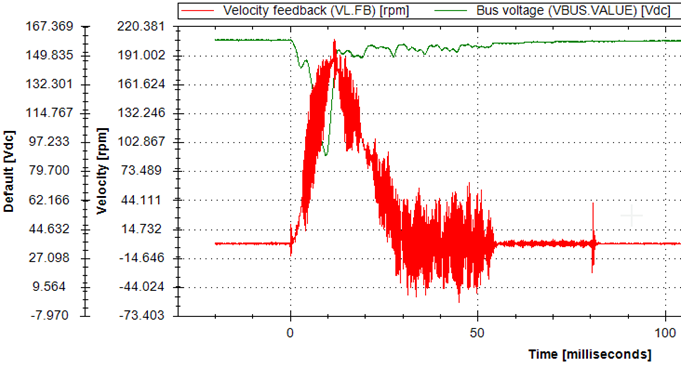
- Notice how the bus voltage starts to dip. The UV fault level is around 90VDC.
- Notice the bus voltage is oscullating at 60Hz. This oscullation creates power in the bus capacitors, and the losses creates heat the capacitor. The AKD has a “Bus Capacitor Over Load” fault that measures the ΔV/Δt and faults the drive if it thinks the capacitors are getting too hot.
- The bus dissipates in about 11mS. Too short a time for the 60Hz (16mS) to charge the bus.