


 Home >
 Knowledge Base >
 FAQs >
 Downloads >
Drive Fuse Sizing
This document refers to G&L PiC application note AN000018 and describes drive fuse sizing. Applies to all G&L Centurionä drives (DSM100, DS100, DS200, and AS100) and motors (SSM, FSM, and HSM).
This application note provides information on the sizing of the fuses for use with G&L Centurion Servo Drives. The approach taken is conservative. In many cases a smaller fuse may be selected if performance requirements are known and guaranteed not to change.
Fuse Sizing Method
To size a fuse the power output (kW) of each axis must be known. This can be derived by calculating the horsepower for each axis and converting that horsepower into units of watts.
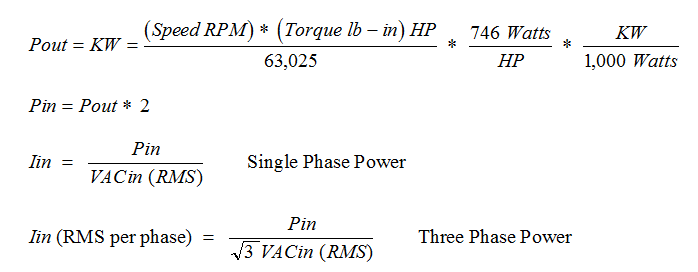
Note: The factor of 2.0 is used to account for the power factor and losses of the system.
If you are using the Systex sizing program, the average speed and average torque data has been calculated and can be used in the above equation.
Example
You are using DS130 drive and SSM460 motor, and you are not sure of the exact speed and torque in your application. Look at the speed/torque curves for the selected drive/motor combination as shown in the Centurion section of the Product Guide. Select the values for the worst case continuous speed and torque. The SSM460 with a DS130 is capable of 4,000 RPM and a torque of 40 lb-in.
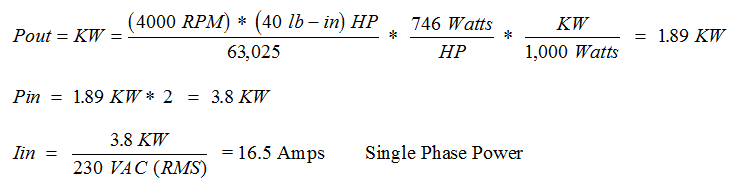
Note: The speed/torque curves are based upon a drive module input voltage of 230 VAC. For a 115 VAC input voltage, the maximum speed is reduced by half.
You should select a fuse with a minimum rating of 17 Amps.
Slow blow fuses are required to allow for in rush current during power initialization at the power terminals. Time delay versions of UL Class J, Class R , or equivalent fuses are acceptable, local regulations must be observed.