


Block and Tackle Series Volume 4 – What Does TENV (Totally Enclosed Non-Ventilated) Mean?
 Question:
What does TENV, or Totally Enclosed Non-Ventilated mean in regard to a servo motor?
Answer:
Well – the answer is simply the motor is Totally Enclosed, and Non-Ventilated
Based on the NEMA (National Electrical Manufacturers Association) definition, a TENV (Totally Enclosed Non?Ventilated) motor has a fully enclosed housing and no fan ventilation. Instead, it relies on unassisted cooling (natural convection)—meaning the motor sheds heat to the surrounding air and/or conducts heat through the mounting surface. There are no fans and no liquid-cooling techniques involved.
Key points about TENV motors:
- Cooling method: Natural convection (no forced airflow)
- Heat path: Released to ambient air and/or conducted through the mounting surface
- Not airtight: Not intended for wet environments
- Where they can work: Slightly damp areas and dirty environments
- Where they should not be used: Hazardous or explosive environments
Electric motors generate heat, and their continuous performance ratings depend on how much heat they can dissipate. That’s why many motors use fan cooling—to help move heat away from the windings and housing. However, many industrial environments are not ideal for fans, because fans can get clogged with debris and lose cooling effectiveness. Fans can also stir up and spread dirt, which can create unpleasant conditions or even damage products or processes. Liquid cooling is another option, but it typically requires routing fluid (often already present on the machine) through piping around the motor housing—an approach that adds cost and complexity.
So when a customer asks for a **TENV motor**, what they usually mean is:
- “I need a fully enclosed motor.”
- “I can’t have a fan.”
- “I don’t want to add liquid cooling.”
In other words, **TENV** is a common shorthand request—but it also has a specific, official definition.
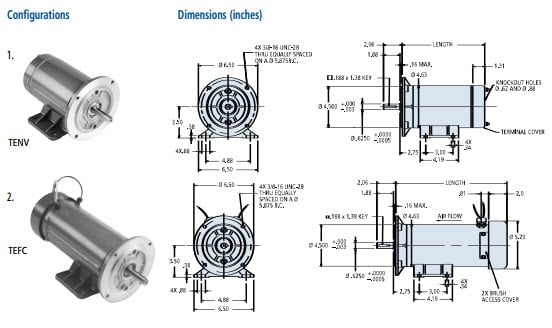
If you’ve ever wondered why you can’t just add a separate fan when the environment isn’t dusty or dirty, that configuration is classified differently. Once you use an external blower, the motor becomes a TEBC (Totally Enclosed Blower Cooled). Why “BC” and not “FC” (fan cooled)? Because TEFC is already taken: Totally Enclosed Fan Cooled**, meaning the motor has an external fan that is **part of the motor** and turns whenever the motor turns.
Finally, servo motors are often TENV motors**. When sizing an application, engineers consider temperature ratings under various operating conditions as part of selecting the right motor. That’s why environmental details matter during application discovery—if you’re not using special cooling methods, you need to confirm the motor won’t overheat in your real-world conditions. Temperature information should be provided upfront by the supplier, but it’s always smart to ask for it if it isn’t clearly listed.
On a slightly different but related topic - another rating you may be interested in would be the Ingress Protection or IP Rating - More information can be found on our blog post entitled “4 Tips for Considering Your Servo Motors IP Rating in Your Application”, by Gene Matthews.